
New Philosophy Students
Welcome to philosophy! You’ve accepted your offer of admission, and have officially joined Concordia. There are a few things you will want and need to do as a new philosophy student.
To-Do
- You must meet with the Undergraduate Program Director (aka. the “Program Advisor”) to be able to register for courses. You will not be able to register for any courses until you meet with them. Email the Departmental Assistant (philosophy dot fas at concordia dot ca) to register for an advising session.
- Register for your courses in accordance with the honours, major, or minor program checklists. Note that PHIL 260 and PHIL 261 are generally required in your first year.
- Check out Concordia’s bookstore see which and purchase books required for your courses.
- Bookmark and join the Students of Philosophy Association Facebook page, Facebook group, and website to make use of our services and see what your department student association is up to.
The philosophy department website also has a neat checklist like this one.
Philosophy Programs
The undergraduate philosophy BA program at Concordia University offers a major, minor, and honours program. The major program is the standard philosophy degree and offers a good distribution and depth to the field of philosophy. The minor program is a shorter program good for getting your feet wet and getting a taste of philosophy. The Honours in Philosophy program is an intensive and longer program that consists of more upper-level seminar courses.
Major
The Major program consists of 36 credits. It is completed in three stages. The department offers a checklist of the major program.
In the first stage, you take foundational courses in critical thinking or logic; ethics; philosophy of science, epistemology, or metaphysics (analytic philosophy); and ancient philosophy. In the second stage, you take some history of philosophy in modern philosophy and one other period of your choosing (medieval, 19th century, 20th century, or Chinese philosophy).
In the last stage, you have the freedom to choose. You take two courses at any level and two courses at the 400-level. 400-level courses are more intensive and are seminar-style and include both undergraduate and graduate students.
Minor
The minor program consists of 24 credits. It offers some taste and basic training in philosophy. You will take foundational courses in two of three main branches of philosophy (chosen from ethics, epistemology, or metaphysics). You choose any two courses at 200-level or higher and any four courses at the 300-level or 400-level. There’s a lot of choice with the minor, and you can choose to specialize in any part of philosophy or take a broad variety of courses. The department offers a checklist of courses for the minor.
| Choose two (6 credits) | Introduction to Ethics (232) | Introduction to Epistemology (263) | Introduction to Metaphysics (265) |
| Choose one (3 credits) | PHIL-2xx | PHIL-3xx | PHIL-4xx |
| Choose one (3 credits) | PHIL-2xx | PHIL-3xx | PHIL-4xx |
| Choose one (3 credits) | PHIL-3xx | PHIL-4xx | |
| Choose one (3 credits) | PHIL-3xx | PHIL-4xx | |
| Choose one (3 credits) | PHIL-3xx | PHIL-4xx | |
| Choose one (3 credits) | PHIL-3xx | PHIL-4xx | |
| Total: 24 credits | |||

Honours
The Honours in Philosophy program at Concordia is 60 credits, nearly double the credits required for the major. The main difference is in the number of 400-level courses you need to take. Like the major, it is also broken down into three stages.
In stage I, and similar to the major, you take foundational courses in logic; ethics; philosophy of sicnece, metaphysics, or epistemology; and ancient philosophy.
In stage II, you take an analytic philosophy elective, intermediate ethics or political philosophy, courses in the history of philosophy in modern philosophy and one other period of your choosing (medieval, 19th century, 20th century, or Chinese philosophy). You also have a chance to specialize in an area of your choosing by completing 12 credits (four courses) in 300- or 400-level courses.
In the final stage III, you take advanced ethics, feminist philosophy, or political philosophy. You take a course of your choosing in logic or analytic philosophy (advanced logic, language, science, epistemology, metaphysics, or phenomenology), a course in the history of philosophy, and then three 400-level courses of your choosing. These will all be advanced seminar-style courses.
See the checklist for more information.
Concordia no longer allows direct entry into honours programs. To get into the philosophy honours program, you must first complete 30 credits at Concordia and have a GPA of at least 3.3, then you can apply for a change of specialization into the honours program. Inform the Undergraduate Program Director of your interest in transferring to the honours program and they will submit the request on your behalf.
In most cases, the honours degree is required to get into post-graduate philosophy programs.
Bachelor of Arts Degree Requirements
Note that any degree at Concordia University is at least 90 credits. For instance, the philosophy major program is 36 credits, and the university requires all Arts and Science students to complete at least 24 credits outside their main discipline, including 6 electives outside of the humanities disciplinary sector.
This means you need to take at least 18 credits immediately outside of philosophy and 6 credits outside of the humanities. The remaining 54 credits can be completed through either a minor program, another major, or an elective group.
Considering the various circumstances that can affect a student’s degree requirements, such as exemptions, deficiencies, transfer credits, Mature Entry Program requirements, Extended Credit Program requirements, and more, it is advisable to consult an Academic Advisor in Student Academic Services within the Faculty of Arts and Science for any questions regarding your specific degree path.
General education electives
The 6 credits required outside the humanities can be in science (biology, chemistry, physics), social science (sociology, anthropology, religion, political science) or other non-humanities courses. The humanities departments are Classics, Modern Languages and Linguistics, Communication Studies, English, French Studies, history, Journalism, Liberal Arts college, Philosophy, School of Irish Studies, and Theology.
So, a student must take 18 non-philosophy credits and 6 credits outside the humanities departments listed above. See the undergraduate calendar for more information.
In short, to complete the philosophy major program, you take 36 credits. To get a Bachelor of Arts at Concordia (in philosophy of course), you need to take at least 54 more credits. Of which 18 of these 54 must be outside philosophy and 6 outside the humanities.
For instance, courses from groups A, B, C, and D must total at least 24 credits. There must be at least 6 credits from groups B, C, and D. You could take all your 24 credits in B, C, or D. Group A is optional, but B, C, and D are not. Note: any courses from group D can be hard to get into and often require special permission.
This can be done in conjunction of two major programs, the major and a minor from another department, the major and an elective pack, or the major and any electives at all.
Courses
Summer courses
Unfortunately, the philosophy department only offers one philosophy course in the summer. This is PHIL-210: Critical Thinking. It’s an eConcordia course (completely online). If you wish to study during the summer, you could opt to take courses from your general electives, minor, or second major (if you have one).
During summer semesters, students are considered full-time if they are enrolled anywhere from 9-12 credits. The summer semester is divided into three parts: Summer 1, Summer 2, and summer 3. Starting Summer 2023, Summer 1 is from May to June (6 weeks); Summer 2 is from May to August (12 weeks); and Summer 3 is from late June to August (6 weeks).
The shorter terms (6-week terms) are basically 12 weeks crammed into half the time. You cover the same material as a 12-week term in half the time. As such, the work required for this course is double what it would be for a 12-week term. It’s not recommended to take more than 2-3 courses in any 6-week term.
Advice on selecting courses
To complete a schedule, I generally recommend students take two to three core courses from their program, one general elective course, and one course from their selected minor. This is considering a full-time student. Anyone registered from 12-15 credits is considered full-time unless under special circumstances.
Here’s how we recommend you build your schedule:
| Fall | Winter |
|---|---|
| PHIL-xxx | PHIL-xxx |
| PHIL-xxx | PHIL-xxx |
| General Elective | General Elective |
| Minor course / elective | Minor course / elective |
| PHIL-xxx | PHIL-xxx |
Of course, you don’t have to design your schedule this way, but this is generally a good spread.
Note that students often take the summer semester off (it’s optional to enroll in courses), but you can always take up to 12 credits in the summer.
For help choosing your courses, you can contact the philosophy program advisor (Undergraduate Program Director).
Philosophy Courses
200-level courses
The 200-level courses are often very foundational and offer some basic skills in philosophy. They generally look at very specific readings and readings can be anywhere from a few pages up to 40 pages a week. There’s often quizzes or a midterm, and sometimes short reading comprehension quizzes. You will also have several short essays to write (generally 400-1000 words). These essays are mainly exegetical. Exegetical essays don’t argue for some opinion, but rather clearly states the author’s meaning from a specified passage or topic.
Most often the professor will provide a clear and detailed presentation of the readings, concepts, and terms. They will go through it slowly and purposefully.
300-level courses
The 300-level courses assume you have the basic knowledge of the 200-level courses. It assumes you can do exegesis and can handle longer readings and longer essays. The essays in these courses may be anywhere from 750-3000 words.
The professor will assign readings, which are to be done before class. The professor will lecture during class time, and discussion is encouraged. Some professors will require you to submit reading questions, based on the readings, and are discussed in class. The readings can be anywhere from 20-60 pages per week per course.
The essays at this point have higher expectations, and you will write full papers (introduction, body, conclusion, and works cited/references), as opposed to the short exegeses of the 200-level courses. The 300-level essays will contain an exegesis portion and you will be expected to also argue an original point in a coherent essay. You may be expected to find sources outside of the course readings, and so some research is mandatory.
400-level courses
The most senior courses an undergraduate student will take are 400-level courses. These are more intensive and assume that a student either has a good grasp of philosophy and of the basics of the course topic. The courses are-seminar style and include both undergraduate and graduate students. The coursework for undergrads is often slightly different than for graduate students.
In these courses, you may be asked to read anywhere from 40-100 pages or more per week. You may also be asked to write weekly short summaries of the readings. You will often have one or more long essays consisting of between 2000-4000 words. You may also have shorter essays of 1500-2000 words or even several very short exegesis or precis of 200-500 words.
These courses are often much more open and “relaxed” in that you’re given instructions on what to read and optional readings, and then you can often write your essays on any topic related to the course. The discussion is also much more open and freer.
The essays in these courses expect close readings of the texts and that you’ve done your own research.
Conferences
Many 200-level core courses have a conference component. Conferences are led by graduate students, called Teaching Assistants, and are small, discussion-based class meetings. Conferences have about 20 students registered, and often only about 3-10 show up. I was once even the only person in attendance and I was able to have some one-on-one time with a graduate student!
During conferences, the conference leader will take a slower and more detailed look at material discussed during that week’s lecture(s) to make sure you understand the concepts. They will provide tips for succeeding in the course. There will also be open discussion and questions in a smaller, lower-stakes environment. It’s recommended to attend these sessions as they will provide training on how to succeed and you can discuss any questions you have.
Course Progression
Some courses have prerequisites, which are conditions that need to be satisfied before taking the course. In philosophy, it is usually one specific previous course, or a certain number of credits. For instance, to take PHIL-261 you need to have taken PHIL-260. PHIL-260 is the prerequisite for PHIL-261.
See below for a chart indicating a diagrammatic representation of the course flow for the honours program (also applies to the major).
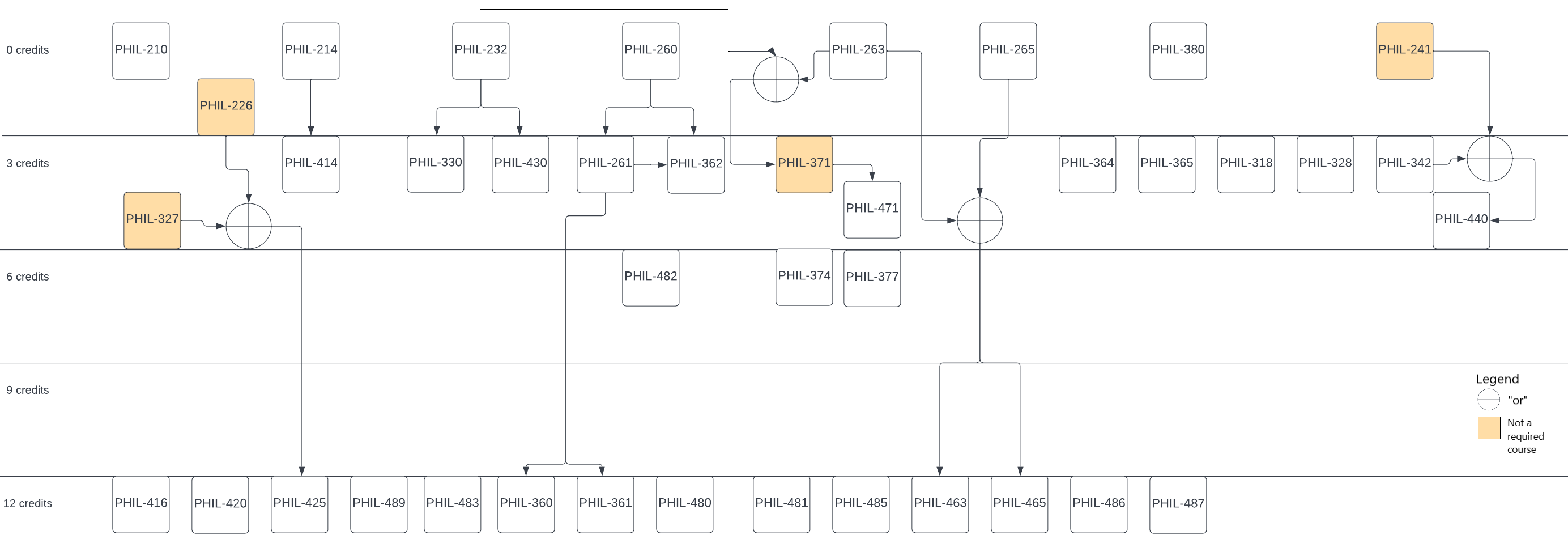
Alternatively, you can download an excel we created detailing the same information.
*Note, that this diagram doesn’t take into account the new 2023-2024 degree requirements (mainly the addition of PHIL-220 and PHIL-429 as electives)
See the official undergraduate calendar for philosophy degree and program requirements.
Continue to “What is Philosophy?“
Return to the Introduction
 Students of Philosophy Association